
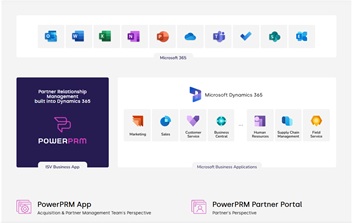
Examining the largest Customer Relationship Management solution providers, such as Microsoft (Dynamics 365), Salesforce, and HubSpot, reveals that they are developing dedicated Partner Relationship Management systems operating within their specific ecosystems.
This is a natural consequence of the interaction and overlap between direct and indirect sales. It reflects how sales are reported and how the value of sales channels is calculated.
This unified approach to CRM and PRM solutions also brings additional benefits unrelated to the sales process itself.
One unified CRM + PRM ecosystem: key benefits for indirect and direct sales
Shared pipeline in CRM and PRM
Direct and indirect sales channels often work on the same leads, compete for the same sales opportunities, and participate in the same forecasting process. As a result, they may experience friction such as:
- deals cannibalization,
- duplication of sales opportunities,
- issues with lead distribution.
Additionally, inconsistent data models lead to unpredictable frecasts and disconnect between the two channels.
Operating a CRM together with a PRM in one ecosystem solves these challenges by enabling both channels to work on the same objects (such as accounts, contacts, or opportunities in Dynamics 365).
Partner deal registration becomes a natural part of the pipeline that is visible to all parties, and data is not siloed within channels. Consequently, forecasting can be performed holistically.
Consistent reporting and data model with CRM & PRM in one system
When examining sales across different channels, we want to know:
- how the pipeline is split between them,
- where conflicts occur,
- which partners generate the highest revenue,
- what does the combined forecast looks like.
We need more than just data; we need information that allows us to continuously learn and improve our actions in individual sales channels.
This can be difficult to achieve when data:
- is scattered,
- has different structures,
- is synchronized with delays,
- is governed by different logic.
A CRM and PRM operating in one environment provide a unified data structure and logic, consistent metrics, a holistic view, and consistent dashboards for the entire organization. This creates a single source of truth rather than an integrated report.
Lower cost and reduced risk vs. external PRM tools
Each integration between CRM and PRM:
- requires additional implementation costs,
- increases maintenance costs,
- poses risks with every update,
- creates another potential point of failure.
Adding an extra system also means:
- adding login processes,
- security mechanisms,
- a new interface,
- a new way of working that users must learn.
In an ecosystem approach, data is immediately available in a single database without being integrated. Users do not need to be synchronized because they use one account and one set of login credentials. There is one security model. Users work with a familiar, user-friendly interface, and implementation is much faster than with an external system.
These features accelerate adoption, shorten time to value, and lower the total cost of ownership.
Security & compliance in a unified CRM + PRM environment
Regardless of the channel, sales involves access to:
- customer data,
- pricing,
- discounts,
- forecasts,
- products, and much more.
Often, this data is personal and sensitive. Meeting appropriate requirements and adhering to procedures is necessary for this.
With an external PRM model, an additional system must be managed, including a second database, data exchange channels, separate security and access mechanisms, and separate audits.
However, if CRM and PRM operate together in one environment, e.g. Dynamics 365, the same SSO, MFA, and role and permission management mechanisms are used. The audit, compliance, and security processes are unified, which makes a significant difference for the departments responsible for these areas.
AI and automation when CRM and PRM operate in one data layer
In order to create cross-functional automations and effectively train AI agents to genuinely automate and support sales channels, a complete picture of activities, processes, and data must be provided. Without this, an agent will only “see” a fragment of the data and lack a full view of the customer or the relationships between sales channels.
When PRM operates within the same ecosystem as CRM, the agent has much easier access to:
- the full pipeline,
- customer and partner history,
- products,
- prices,
- discounts,
- sales and partner activities,
- historical results.
Consequently, AI can serve as not only a chatbot or summarization tool but also a mechanism that supports sales decisions.
When does an external PRM system makes sense?
There are situations in which using an “external” PRM is justified and may be a better solution, though not necessarily. However, this only applies to business models that differ from those in which CRM is the central system.
When PRM operates as the central system
Some organizations base their entire business model on partnerships, so direct sales are minimal or nonexistent. In these cases, PRM is the primary system, and other organizational applications adapt to it.
When choosing an independent PRM solution provider, consider whether they will be able to deliver other solutions with similar technology that will complement and integrate easily with the PRM.
When CRM is not part of a single, cohesive ecosystem
This situation applies to organizations that do not have a single global CRM system and use different CRM systems in different regions or business lines. These organizations are not ready or willing to standardize their sales processes. In this case, PRM aggregates partners independently of the operating CRMs.
However, this approach does not seem to be the target model for companies that want to manage sales in a scalable way.
When partner sales are fully autonomous
Using an external PRM may also be beneficial when indirect sales do not overlap with direct sales, when there are no shared leads, customers, or products, and when the channels do not compete with each other. With this model, the issues mentioned earlier regarding the intersection of direct and indirect channels are avoided, allowing for purely technical integration.
A decision dependent on the business model
An external PRM is not inherently more advanced or functionally superior simply because it is a separate system. While it can offer rich functionality, it loses sales context and requires continuous effort to connect partners with direct sales.
This is why, despite having an external PRM, some companies return to the question after scaling direct sales and facing increased reporting and forecasting requirements: “Why isn’t our partner channel part of the same sales picture?”
Therefore, if an organization:
- direct and indirect sales coexist,
- the pipeline must be shared,
- reporting must cover the entire organization,
- security, compliance, and automation are important,
then, CRM and PRM operating within a single ecosystem will be the natural choice.


