
Challenges and opportunities when managing a Partner Sales Channel (PRM) in the Microsoft Dynamics 365 ecosystem
 Artur Zyzak November 24, 2025
 You read:
Challenges and opportunities when managing a Partner Sales Channel (PRM) in the Microsoft Dynamics 365 ecosystem
Microsoft Dynamics 365 has become a global platform for organisations looking to optimise sales, marketing, operations, finance, and customer engagement. With more than 80,000 companies using Dynamics 365 worldwide, the platform is well established as a foundation for mission-critical business processes.
But there is one major challenge that many organisations discover only after building their processes around Dynamics: there is no native, comprehensive solution for Partner Relationship Management (PRM).
For organisations that rely on channel partners, distributors, agents, resellers, or service providers, this challenge cannot be ignored.
While some PRM-related elements can be addressed through custom CRM configuration, Case Management in Business Central, or Power Pages, these tools fall short of supporting the full partner lifecycle without extensive—and often risky—customisation.
Why PRM is different than CRM
Partner ecosystem management introduces workflows that are fundamentally different from customer-oriented CRM processes. Organisations must coordinate both transactional and non-transactional collaboration with partners, often at scale. This includes onboarding, training, certification, partner communication, co-selling, marketing alignment, and after-sales support.
Industries such as manufacturing, retail, distribution, finance, and insurance, which deliver complex and expertise-driven solutions, rely on specialised Partner Management, Vendor Management, or Third-Party Risk Management processes. Yet many organisations still lack a dedicated PRM platform within the Microsoft Business Applications ecosystem.
This article focuses on the challenges and requirements of channel partner sales, particularly for organisations operating on Microsoft Dynamics 365 Sales.
Challenges in managing a Partner Sales Network
Multi-channel sales reality
Most companies operate across multiple sales channels—direct and indirect— while partners simultaneously run their own marketing and business development activities. Although these channels often target the same prospects, they frequently operate independently, which leads to:
- unclear market segmentation,
- conflicts between territories,
- inconsistent approaches to lead registration and deal attribution,
- channel cannibalisation,
- non-standardised documentation and training,
- lack of unified reporting across all channels.
Why the Partner Portal is essential
A good Partner Portal is what makes scaling possible. It centralises activities that partners should handle independently, without constant involvement from internal teams. This includes:
- partner onboarding to the solution, processes, and knowledge base,
- training, certification, and audits,
- joint marketing programs and MDF management,
- lead registration and deal management,
- co-selling workflows,
- case and service management.
The Partner lifecycle
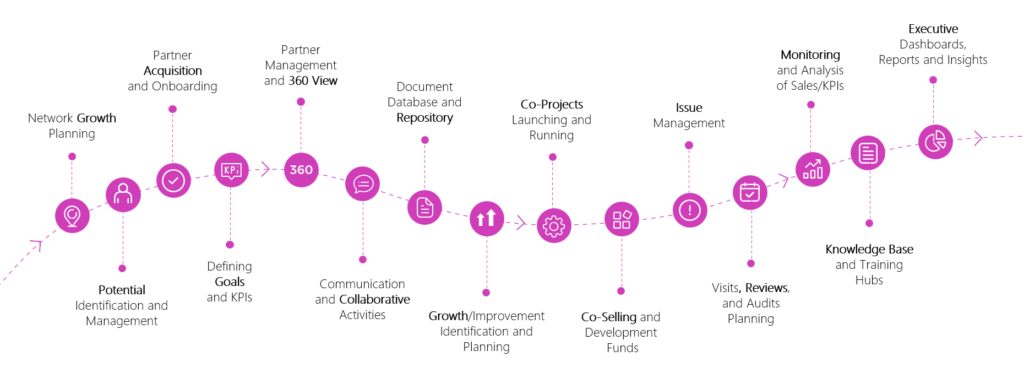
Partner lifecycle management differs significantly from customer lifecycle management. Partners are recruited, qualified, onboarded, trained, incentivised, and monitored for performance. A partner may or may not generate sales, which is why ongoing activation and engagement are essential.
1. Partner acquisition and qualification
In partner channel development, instead of prospective customers and sales opportunities, organisations work with potential partners who are qualified to become partners. A partner is not a customer, but represents the product or service to the end customer. Depending on the partner program, the relationship may not be formally documented until the first transaction, may require periodic re-certification, and may apply to individuals, companies, or capital groups.
2. Partner onboarding and management
Qualification is only the starting point for structured cooperation, often focused on joint sales. Partners need access to knowledge, documentation, and tools that enable effective business development and sales. When onboarding and enablement materials are extensive or frequently updated, a Partner Portal becomes an effective way to distribute information, training, and documentation.
Unlike customer portals, Partner Portals are more proactive, involve multiple users on the partner side, and support two-way communication.
3. Joint marketing campaigns
Program managers may offer partners marketing materials, Market Development Funds (MDF), or coordinate joint marketing campaigns. This introduces PRM requirements related to permissions, access control, and clear separation between marketing, sales, and service areas, as well as between internal teams and partner users.
4. Joint sales
In practice, many qualified partners—especially in enterprise B2B— do not actively sell on their own. Partner management focuses on activating engagement toward customers. Territory splits may result in partners and direct sales teams targeting the same accounts, creating channel conflict and cannibalisation risks.
Joint sales, lead registration, opportunity handling, and commission models require clearly defined processes and supporting tools, typically delivered through a Partner Portal.
5. Post-sales support
A common operating model shifts parts of post-sales service to partners, such as first-line support or basic warranty handling. This requires tools to manage customer-initiated cases, assign responsibilities, support partners with training and knowledge bases, and monitor service quality, response times, and resolution performance.
Why PRM matters for Sales, Product, CS, and RevOps
A strong PRM setup affects the entire revenue engine:
- Sales leadership (CRO, CSO, CCO, CGO) expects unified processes, tools, and metrics across direct and indirect channels. PRM and CRM should form one consistent working environment.
- Partner Development Managers need specialised tools that go beyond traditional CRM. Developing and managing a partner channel—while partially similar to customer acquisition— represents a fundamentally different type of process.
- Customer Success teams must align partner performance with customer expectations. They recognise that the quality of after-sales activities delivered through partners directly impacts brand perception, product satisfaction, and the experience of customers supported by direct teams.
- Product teams depend on structured partner feedback loops. When sales and parts of after-sales processes are handled by partners, product teams gain new opportunities—but also face new challenges.
- Revenue Operations (RevOps) requires consistent data across CRM and PRM to deliver accurate performance insights. A unified, trustworthy data foundation covering all channels is therefore critical from a RevOps leadership perspective.
Summary
Traditional CRM and ERP systems were never designed to handle the full complexity of Partner Relationship Management. Effective partner ecosystem management requires tools that support partner recruitment, onboarding, joint marketing, co-selling, deal registration, after-sales operations, and performance monitoring.
A dedicated PRM platform becomes necessary in large or geographically distributed partner programs, serving the needs of sales leadership, partner development, customer success, product teams, and Revenue Operations (RevOps).