

Home / PRM for Dynamics 365
PowerPRM for Dynamics 365
If you are currently using Dynamics 365 and are developing a partner channel, it would be advisable to consider the implementation of a PowerPRM – certified PRM solution available on MS AppSource. This platform was created specifically to support partner management in the D365 environment.

PRM and Dynamics 365 on a single, unified platform
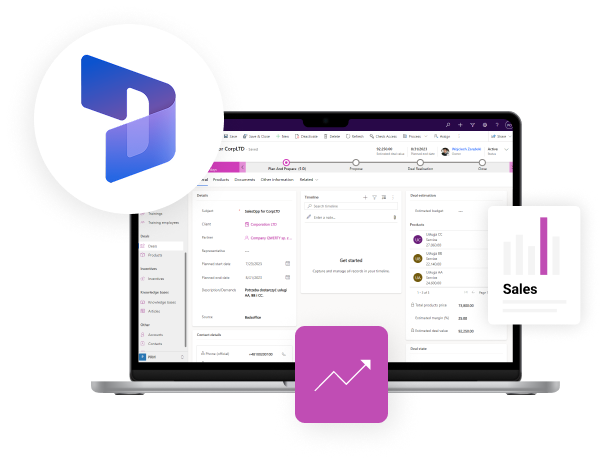
PowerPRM and Dynamics 365 Sales share a common database, ensuring data consistency, reporting, and ease of exchange while maintaining maximum security. Concurrently, it is feasible to maintain entirely distinct configurations for both solutions, ensuring that PowerPRM does not modify existing processes in D365 Sales.
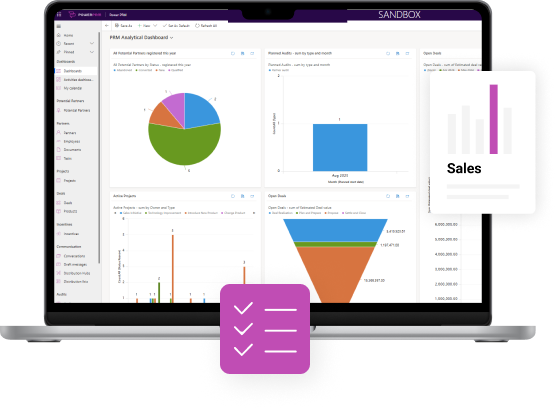
PowerPRM is fully compliant with Microsoft standards, offering a comprehensive suite of features including role and permission management, change control, backup copies, unified reporting based on PowerBI, Power Automate automation, and Copilot support—all without the need for complex integrations.
This places it at the forefront as the preferred PRM solution for D365.

Aligned Marketing, Sales and Partner Management Teams
A single database and similar data model elements are key to the direct use of shared entities by PowerPRM and D365 Sales. The most common scenarios involving Sales and Partner Management teams working on Account, Contact, Lead, and Opportunity entities. This approach facilitates the harmonious integration of both indirect and direct sales channels, fostering a collaborative environment where they complement each other avoiding cannibalization and customer related conflicts.
01
Dedicated entities: Potential Partner and Partner
PowerPRM provides separate Potential Partner and Partner entities from the Account entity. This creates entirely new possibilities for Account–Partner, Partner–Partner, Opportunity–Partner–Account, and Lead–Partner–Account relationships, as well as custom rules, processes, and workflows within the Partner area. The result is greater transparency, better management, and fewer conflicts between channels.
02
Separate pipelines for partner leads (MQL) and partner opportunities
With PowerPRM, you can create distinct pipelines for partner leads (MQL) and partner opportunities. This simplifies management, increases clarity, and improves the view of the end customer and forecast by separating direct and partner sales processes and histories. Teams can prioritize actions more quickly and prevent cannibalization.
03
Configurable partner processes that go beyond the D365 standard
With PowerPRM, you can configure processes specific to partner management, such as onboarding, certification, training, audits, and joint projects. Each process can have its own workflow, checklist, evidence, automated tasks, and approval path. Additionally, a dedicated Partner Portal can support processes.
04
Partner Portal as an extension of the PRM application
The Partner Portal allows partners to register leads, participate in joint projects, and access training materials. The integrated partner application promotes co-selling and co-marketing, enhances pipeline transparency, and mitigates customer conflicts.
Two solutions - one way of work
Implementing PowerPRM in the Dynamics 365 environment ensures a consistent solution logic across the board. Both the PRM and CRM solutions use the same database and information structure and have identical automation, alert, and notification mechanisms. This allows partner and customer relationship management to follow the same business rules, which simplifies implementation, adoption, and daily work.
Integrated Microsoft Teams enables teams to exchange information seamlessly without having to switch between different communication tools. Users of D365 Sales do not need to learn a new solution — they can easily access PowerPRM and find the same familiar mechanisms and interfaces.
Single source of truth about customers
All data concerning end customers and related activities is collected and analyzed on a single, integrated platform. This enables us to eliminate information silos between direct and partner channels — all knowledge regarding relationships, sales, and activities is entered into a shared database.
This architecture enables us to create cross-sectional reports and analyses covering all direct and partner sales processes. From the perspective of RevOps teams, this is a real breakthrough. They now have access to uniform, reliable data, which allows them to make quick decisions, optimize activities, and effectively manage channel efficiency. Reporting and analytics are more accurate and simpler.
As a result, the organization gains full control over knowledge of its end customers, as well as tools for continuously improving sales and partner processes based on reliable, up-to-date information.
CRM & PRM for Dynamics 365
Thanks to the use of existing architecture, implementation is quick.
The solution is easier to adopt thanks to a familiar UX.
You maintain unified reporting across the entire D365 ecosystem.
Thanks to a low-code approach, there are extensive configuration options and quick implementation of adjustments.
Security is ensured by Microsoft standards.
You gain support from consultants and architects who are experienced in both PRM and CRM.